
AI agents · Overview
AI agents for business:
use, control, limits
The word agent is used for very different things. Here is the view from practice: what sets an agent apart from a chatbot and from a fixed workflow, which processes suit them and what a controlled operation requires.
Chatbot, workflow or agent?
In practice the line is blurred. Many good solutions are workflows with a few agentic steps. To choose, it helps to ask who decides the next step.
Chatbot
Answers questions in a conversation.
- Input and output are text
- Does not act in systems itself
- Good for information, drafts and summaries
Workflow
Runs a fixed sequence of steps, including AI steps.
- The sequence is defined in advance
- Predictable and easy to test
- Good when the process is stable and clear
Agent
Pursues a goal and picks tools and steps itself within narrow limits.
- Uses tools such as search, interfaces and databases
- Decides on the next step
- Needs rules, approvals and logging
What an agent needs
An agent is more than a model with a prompt. These building blocks belong to every productive implementation.
Task and success criterion
A clearly defined task and a definition of when the result is good enough.
Tools
Access to search, calculation functions and interfaces, each limited as narrowly as possible.
Data sources
The systems and documents the agent reads from, such as CRM, databases or knowledge collections.
Rules and limits
What the agent may do, what it may not, and when it must stop or ask.
Approval
Levels at which a person checks before anything is written, sent or changed.
Log and monitoring
Every run is recorded so results can be traced and errors narrowed down.
Typical business processes
Suitable are recurring tasks with clear inputs, results that can be checked and access to the data they need.
Research and summaries
Gather information from several sources and prepare it in a structured way.
Evaluating documents and emails
Sort incoming material and extract details. More under Processing documents with AI agents.
CRM maintenance
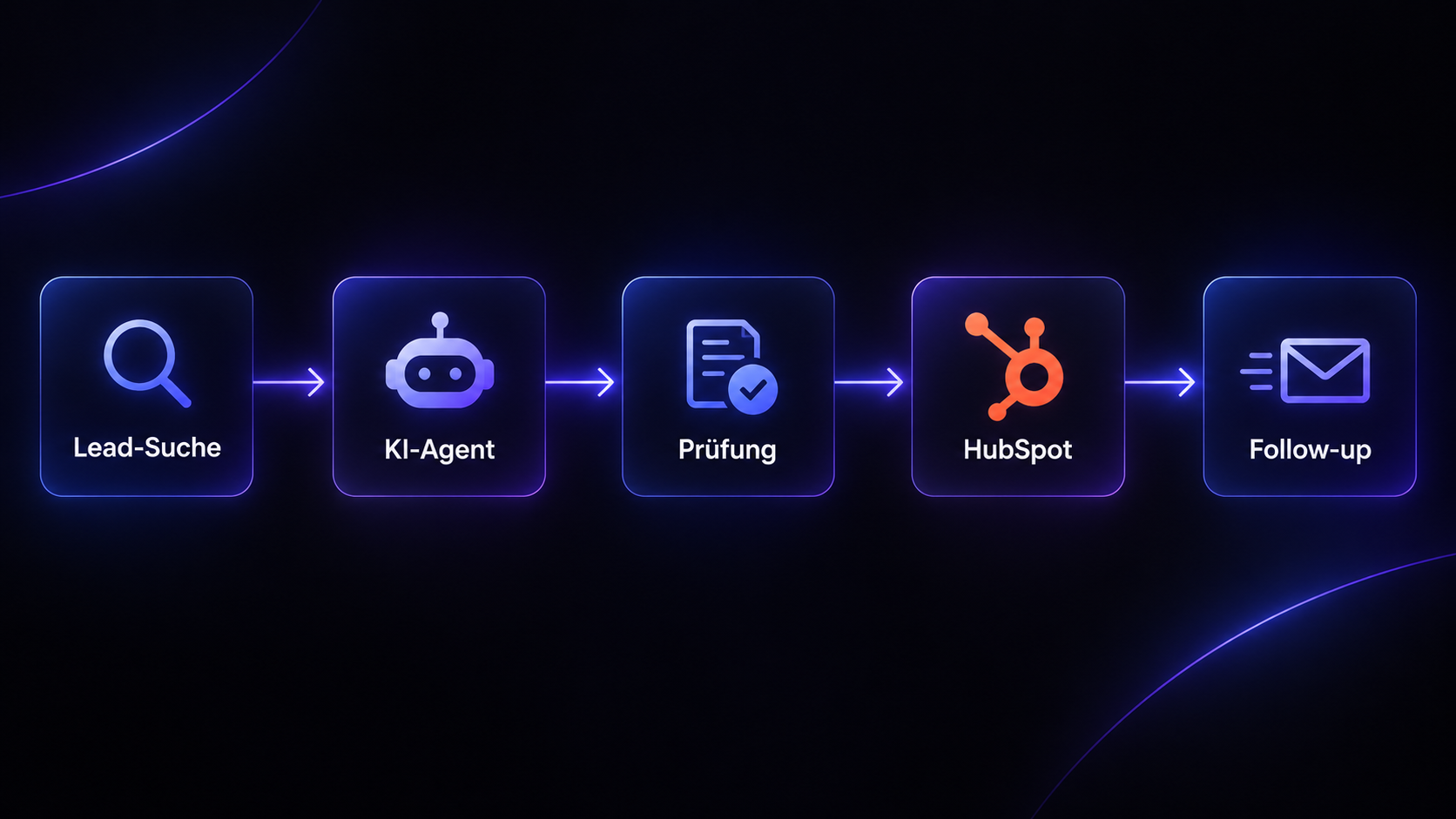
Complete records, qualify enquiries and prepare follow-up steps. More under AI agents for CRM and HubSpot.
Reports and analyses
Compile recurring reports from several sources.
Sorting enquiries
Classify incoming requests and pass them to the responsible person with a summary.
Control: human in the loop
The greater the impact of an action, the later the agent may carry it out without a person. We therefore work with approval levels. Reading is usually uncritical, suggestions are the next level, writing into defined fields the one after. Actions with external effect, such as sending a message, go through an approval.
An agent should also be switchable off and traceable. Every change is logged with its source and reason.
- Permissions as narrow as possible
- Approval before actions with external effect
- A log of every run
- Stop and ask when unsure
Limits
AI agents make mistakes. They can summarise information wrongly, invent connections or react incorrectly to unusual inputs. That is why decisions with legal or financial weight do not belong in an agent's hands without review.
Quality also depends on the data. An unclear process does not become clearer with an agent, and every run costs money and takes time. We check this with real data in a prototype before anything is rolled out.
From idea to operation
01 Process workshop
We analyse the process and the systems involved and choose a suitable use case.
02 Prototype and test
The agent runs on real data with clear success criteria, at first without write access.
03 Integration and rollout
Connection to the systems, approval levels, training and gradual expansion.
04 Operation and further development
Monitoring, maintenance and adjustment based on metrics and feedback.
Our service for this
We deliver the topics on this page in the following service areas.
Frequently asked questions
What does an AI agent cost?
That depends on the process, the system landscape, the data and the approval logic. After a process workshop we can estimate the effort and the running operation. A flat number would not be honest.
Which models does Trickhouse use?
The choice of model depends on the task, data protection requirements and cost. We prefer open-weight models and open-source software and assess for each use case whether they solve the task well enough.
Where does the data run?
Operation runs in the EU cloud or on your own infrastructure, with roles, permissions and data protection from the start. We define the data flows per project, see Data-sovereign generative AI.
Do agents replace staff?
They take over parts of tasks, mainly research, preparation and setup. Decisions and approvals stay with people. The aim is for your team to spend less time on routine.
How do we measure success?
We set the success criteria before the prototype, for example processing time, error rate in spot checks or the share of cases that run through without a query. In operation we keep watching these values.
Related topics
AI Agent Engineering
Our service area: consulting, implementation and further development.
Learn moreAI agents for CRM and HubSpot
Research, data maintenance and follow-up preparation in the CRM.
Learn moreProcessing documents with AI agents
Classification, extraction and validation with human approval.
Learn moreIntegrating generative AI into existing systems
Connection, roles and approvals as the foundation.
Learn more
Ready for your next project?
Tell us briefly what you want to achieve with generative AI. We advise you on content production, digital twins, AI workflows and integration, and get back to you within 24 hours with an initial assessment.